
Lynchburg City Bench Warrants Explained
Virginia court records use capias, failure-to-appear warrant, and show-cause process for different court commands. In Lynchburg City, a missed appearance in General District Court may lead to a capias or FTA warrant. Circuit and JDR have their own process for felony, juvenile, family, or support matters. The issuing court controls the record and any recall.
A bench warrant is tied to an existing case or obligation. It differs from an arrest warrant issued after a complaint and probable-cause review. A capias can authorize taking a person into custody and bringing them before the court. It does not decide the original case.
Lynchburg City Missed-Court Process
Virginia Code § 19.2-128 treats a willful failure to appear as a separate offense. The possible classification depends on whether the underlying charge is a misdemeanor or felony. The statute also allows the court to consider circumstances such as illness, transportation trouble, dependent care, or prompt efforts to fix the missed date.
Local point: Contact the court that set the hearing and explain the missed date promptly; the research does not show a universal warning period before process issues.
Do not assume that a missed date in one court appears in every online view. Ask the clerk which process was entered and whether the court has received a request to reset or recall it.
How Lynchburg City Bench Warrants Are Issued
A court first records the missed obligation or other reason for process. Under Virginia court procedures, a judge may issue a capias or other FTA process and direct law enforcement to bring the person before the court. The exact form depends on the court and case type. The process may be recorded with a court case number and a unique OTN in the General District Court system.
Once issued, a warrant remains a court matter until it is served, recalled, or otherwise closed through the proper process. OCIS can reveal a case entry, but it is not described as a full public warrant roster. Ask the clerk to confirm the current state before acting on an older notice.
Lynchburg City Capias Forms
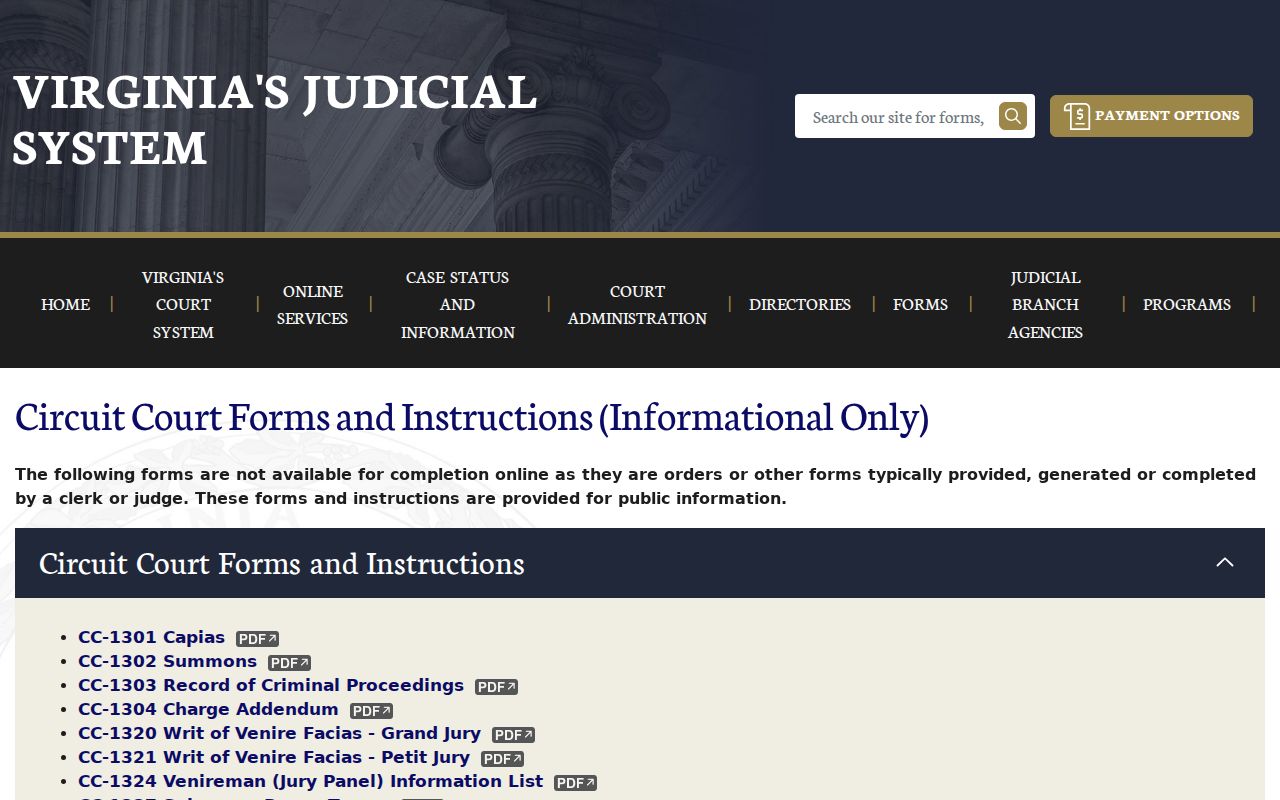
Virginia’s Circuit forms index includes CC-1301 Capias, CC-1355 Rule to Show Cause, and CC-1356 Capias to Show Cause. These are blank form names, not proof that a particular person has a warrant. The state General District Court Manual also describes DC-323, the Recall of Process form used when process is recalled before service.
The official Virginia court-form index is shown here as a terminology reference.
Only the issuing court can say which form or recall step applies to a Lynchburg City case. A clerk can explain filing steps but cannot give legal advice.
Bench Warrants and Arrest Warrants Compared
Both forms can lead to arrest, but they begin differently. A bench warrant responds to a court obligation in a case already underway. An arrest warrant follows a complaint and probable-cause review. The arrest warrant process has its own issuance and service rules.
| Feature | Bench Warrant | Arrest Warrant |
|---|---|---|
| Trigger | Missed date, noncompliance, or show-cause matter | Complaint, oath, and probable cause |
| Issuer | Judge in the court handling the existing case | Magistrate or other authorized judicial officer |
| Case stage | Obligation already set by the court | Investigation or charge alleging an offense |
| Next step | Confirm court appearance or recall procedure | Confirm service, bond, and return court |
Lynchburg City Bench Warrant Courts
General District Court handles adult traffic and misdemeanor cases and felony preliminary hearings. Circuit Court handles felony trials, appeals, and its criminal files. JDR handles juvenile delinquency, juvenile traffic, domestic, custody, support, and related show-cause matters. The court type gives the first clue about which clerk to call.
There is no separate Lynchburg municipal court in the reviewed court structure. City traffic and adult ordinance-related criminal matters route through General District Court. A JDR matter has different access limits, so do not treat a family or juvenile process as an ordinary public adult case.
Resolving a Lynchburg City Bench Warrant
Start by confirming the issuing court, case number, and type of process. Ask whether the court wants a motion, a scheduled appearance, or a bond review. The research did not find a universal warrant walk-in docket, recall fee, or bond window. A lawyer can help arrange the right request and advise whether voluntary appearance is appropriate.
- Call the clerk for the court that set the underlying case and verify the process status.
- Ask a lawyer whether to request a reset, recall, quash, or bond hearing.
- Follow the court’s instructions for appearance or payment; do not assume an unscheduled walk-in is accepted.
- Keep the court’s receipt or written confirmation and ask whether any separate obligation remains.
Caution: Do not ignore court process; get current instructions from the issuing clerk or counsel instead of assuming it has expired.
Lynchburg City Bond Review
A magistrate may set bond when a person is arrested on a capias, and the court can set terms that a magistrate must honor unless the law allows a more restrictive condition. The local Public Defender information says only a judge can reduce a magistrate-set bond. No universal bond schedule or payment method was published in the reviewed Lynchburg sources.
The Public Defender office is at 725 Church Street, Allied Arts Building, eighth floor, phone 434-947-2244. Ask the lawyer or issuing court which review path fits the case. The Sheriff’s courthouse address is not a substitute for the court’s decision on recall or bond.
Lynchburg City Court Reset Rules
General District Court publishes a traffic and criminal continuance policy and a docket schedule. A continuance changes the hearing setting; it does not by itself prove that an earlier warrant or capias was recalled. Ask the clerk whether the case has a separate process entry and whether the court requires a motion or appearance.
GDC criminal and traffic questions go to 434-455-2630 at 905 Court Street. The court lists public hours of 8:00 a.m. to 4:00 p.m. and says it accepts no monetary transactions after 4:00 p.m. Confirm the current docket and payment cut-off before travelling.
Finding the Court That Issued the Warrant
A bench warrant stays with the court that set the obligation. The Sheriff may serve process and the police may help locate or arrest someone, but neither can recall the judge’s order. Find the court name on a summons or case result, then call the clerk and ask for the correct criminal, traffic, or show-cause desk.
If the paper is missing, search OCIS by name or hearing date, choose Lynchburg City, and call the clerk shown in the result. For Circuit criminal questions, the clerk is at 900 Court Street and the Criminal Division is 434-455-2697. General District criminal/traffic is 434-455-2630 at 905 Court Street; JDR is 434-455-2670 at 909 Court Street.